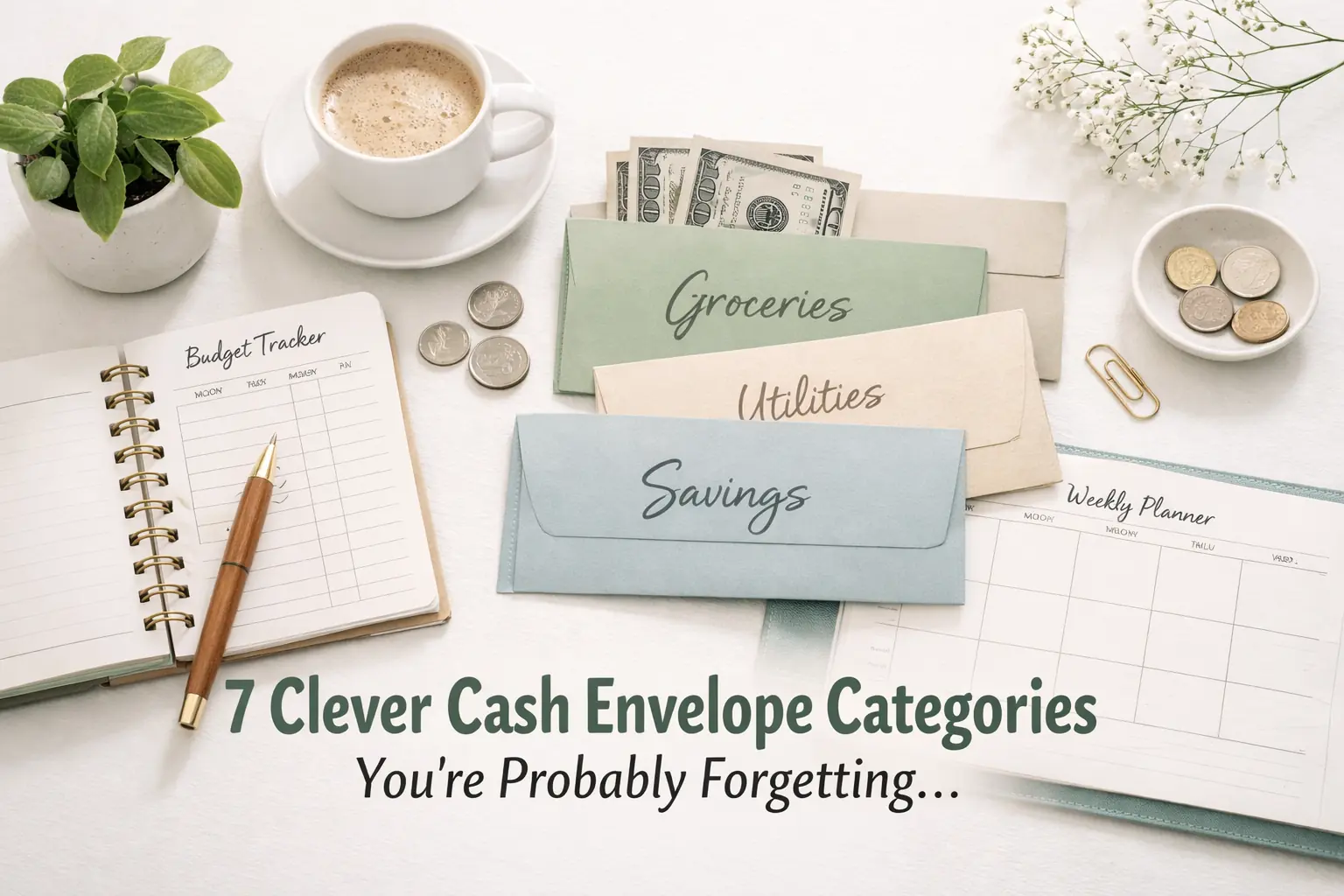
7 Clever Cash Envelope Categories You're Probably Forgetting to Track
Stop budget leaks today! Discover the 7 hidden cash envelope categories you need to include in your list to keep your money organized and your wallet full.
From experience
This article is part of a broader budgeting systems framework that connects with related guides like The Ultimate Budget System, Paycheck Budget System, and Sinking Funds Explained. It reinforces topical authority by covering spending categories, expense tracking, and financial planning within a structured content cluster.
Once upon a time, in a small living room cluttered with receipts, a young couple sat staring at five empty paper envelopes. It was only the 14th of the month. They had followed the standard advice: one envelope for groceries, one for gas, one for dining out, one for entertainment, and one for miscellaneous expenses. Yet, the money was gone. They hadn't bought a yacht; they had simply lived a normal life. This story is the reality for thousands of people starting their journey with The Ultimate Budget System. The problem isn't the method; it is the cash envelope categories list. Most lists are too vague, leaving gaping holes where money quietly drains away. If you find yourself constantly "borrowing" from your gas money to buy a birthday card or a bottle of aspirin, you are experiencing budget leaks. These leaks are the silent killers of even the best financial planning attempts.
Why Specificity is Your Secret Weapon Against Budget Leaks
The cash stuffing community has grown because physical cash provides a tactile boundary that digital swiping lacks. When you see your food money dwindling, you naturally start looking for deals. However, most beginners fail because their categories are too broad. If you have a single envelope labeled "Miscellaneous," it quickly becomes a black hole. In practice, our brains are very good at justifying "needs" when the category is vague. If you define exactly what a dollar is for, you are much less likely to spend it on something else. This is the core of successful financial planning: removing the choice at the moment of purchase by making the choice during the planning phase. When you refine your cash envelope categories list, you aren't just moving money; you are training your brain to see small expenses before they happen.
The 'Buffer Math' Trick: Solving the Empty Envelope Crisis
What most guides miss-and what actually causes people to quit-is the lack of a 'Mishap Fund.' Prices change, math errors happen, and sometimes the sales tax is higher than you guessed. Without a buffer, one small mistake at the grocery store register forces you to raid your other envelopes. To solve this, we use a simple 'Mishap Fund' calculation. This isn't a complex formula; it's a simple rule of thumb for real life. To find your amount, look at the total cash you plan to spend in all your envelopes for the month. For every $100 you spend, add an extra $5 into a separate 'Mishap' envelope. For example, if your total monthly variable spending is $800, you would put $40 into this special envelope. This envelope acts as a shock absorber. It isn't for fun or extra treats; it is strictly for when the total at the register is $52.50 and you only have $50.00 in your grocery envelope. This original data point prevents the 'domino effect' where one empty envelope ruins the rest of your month.
The Step-by-Step Guide to Organizing Your New Categories
- Analyze Your Last 30 Days: Before you touch your cash, look at your bank statements. Highlight every purchase that didn't fit into your current envelopes.
- Calculate Your Total Spend: Add up the total cash you need for the month.
- Apply the 5% Rule: Take that total and set aside $5 for every $100 spent to create your Mishap Fund.
- Pick Your Clever Categories: Use the 7 items listed below to fill the gaps in your cash envelope categories list.
- Label with Intention: Use clear, bold labels. Instead of 'Misc,' use 'The Convenience Tax' or 'Wellness.'
- Sync Your Timeline: Align your cash stuffing with your Paycheck Budget System to ensure you always have cash on hand when the bills are due.
- Review and Refine: At the end of the month, see which envelopes were empty and which were full. Adjust your amounts for the next month.
7 Clever Categories You Are Probably Forgetting
1. The 'Convenience Tax' (Gas Station & Corner Store)
We've all done it. You're running late, you're hungry, and you grab a $4 protein bar and a coffee at the gas station. This isn't 'Groceries' and it's not 'Dining Out.' It is a convenience tax. By giving this its own envelope, you highlight how much your lack of preparation is costing you. Often, seeing this envelope empty is the motivation needed to pack a lunch. This is a primary way to stop budget leaks before they start. According to data from the U.S. Bureau of Labor Statistics, small miscellaneous food purchases are one of the most under-reported expenses in household budgets.
2. Small Sinking Funds for 'Yearly Annoyances'
Sinking funds are usually for big things like car insurance, but what about the $15 annual fee for your library or the $60 yearly software renewal? These small, infrequent costs are tiny budget killers. If you have five of these throughout the year, that's $300 of unplanned spending. Divide these totals by 12 and stuff a small amount of cash each month. You can find more detail on this in our guide to Sinking Funds Explained.
3. The 'Social Obligations' Stash
Birthdays, baby showers, and office collections for a departing colleague can wreck a weekly budget. If you don't have a specific category for gifts, you'll end up raiding your grocery money. Set a flat monthly amount-even $10-to keep in a 'Gifts' envelope. When an invitation arrives, you can say 'yes' without the financial guilt. This makes your financial planning much more inclusive of your social life.
4. Household Consumables (The 'Not Food' Envelope)
Toilet paper, light bulbs, and cleaning sprays are not groceries. If you buy them with your food money, you will eventually find yourself short on dinner ingredients. By separating 'Household' from 'Groceries,' you get a much clearer picture of what it actually costs to feed your family. This is a pro-tip for those trying to save money on groceries.
5. The 'Digital to Physical' Buffer
In a world of online shopping, some cash needs to be set aside to cover digital purchases that should have been cash. If you buy a Kindle book or a $5 app, take $5 out of your 'Entertainment' envelope and put it in this buffer. At the end of the month, deposit this cash back into the bank. This ensures your cash stuffing routine stays accurate even when you shop on your phone.
6. Health & Wellness (The 'Pharmacy' Envelope)
Co-pays, vitamins, and over-the-counter meds often get lumped into miscellaneous expenses. But health costs are a significant part of any budget. Having a dedicated envelope for the pharmacy ensures you aren't choosing between buying your daily vitamins and buying dinner. It provides a sense of security that is essential for long-term budgeting success.
7. The 'Giving & Tips' Envelope
Whether it is a tip for the hair stylist or a few dollars for a local charity, these small acts of kindness add up. If you don't budget for them, you might feel stingy or guilty when the opportunity to give arises. Having $20 in small bills specifically for tips and donations makes these moments stress-free and allows you to be the generous person you want to be.
Common Mistakes: Why Your Envelopes Stay Empty
The biggest mistake is 'Category Creep.' This happens when you start with five envelopes and end up with thirty. If your cash envelope categories list is too long, the system becomes a chore rather than a tool. Aim for a maximum of 10 'active' envelopes that you carry with you, and keep the others as home-based savings. Another mistake is ignoring the change. Coins add up! If you aren't tracking the change from your cash transactions, you are losing 1-2% of your budget to the couch cushions. Finally, don't be too rigid. Your financial planning should serve your life, not the other way around. If a category isn't working, change it!
Essential Tools for Your Cash System
| Tool | Purpose | Why It Matters |
|---|---|---|
| Vertical Envelopes | Organization | Easier to read in your wallet or binder. |
| Budget Sheet | Tracking | Allows you to see the balance without counting the cash every time. |
| A 'Home Base' Binder | Sinking Funds | Keeps your non-daily cash safe and organized in one spot. |
| Mishap Fund Tracker | Security | Shows you how often you are 'missing the mark' so you can adjust your budget. |
To get started quickly, you can use a monthly budget template to map out your numbers before you touch your cash. Remember, the goal is to make the system as easy as possible so that you actually stick with it throughout the year.
The Practitioner's Perspective: Dealing with 'Checkout Anxiety'
What most guides miss-and what actually stops people from using cash-is the anxiety of the checkout line. You are worried about holding up the line while you pull out multiple envelopes. In practice, the best way to handle this is the 'Pre-Sort.' While you are in the checkout line, have your envelope ready. If you have a split transaction (like groceries and a birthday gift), ask the cashier to ring them up separately or pay for the whole thing with your largest envelope and 'pay yourself back' as soon as you get to the car. Most cashiers are incredibly patient once they realize you are organized and ready to pay. Don't let the fear of a 30-second delay stop you from taking control of your financial future.
Conclusion: Your Path to Financial Peace
Mastering your cash envelope categories list isn't about being perfect; it's about being prepared. By adding a 5% Mishap Fund and accounting for things like the 'Convenience Tax' and 'Social Obligations,' you are building a system that can actually survive the real world. You move from wondering where your money went to telling it exactly where to go. This is the ultimate goal of financial planning: peace of mind. Start today by adding just one of these clever categories to your routine and watch how it changes your relationship with your money.
Frequently Asked Questions
- What if I run out of money in one envelope before the month ends? If an envelope runs out, you have two choices: stop spending in that category or move money from a 'wants' envelope like Fun Money. Never move money from 'needs' like Rent. This is why the Mishap Fund is so helpful for beginners.
- How do I handle online bills with the cash envelope system? Online bills are best handled through your bank account. The cash system is for 'variable' expenses-things where the amount changes and you have a choice in how much you spend daily, like food or entertainment.
- Is it safe to keep that much cash at home? Safety is key. Only keep the cash you need for the week or month. Use a small fireproof safe or a hidden lockbox for your sinking funds. For your daily carry, only take the envelopes you know you will need.
- How do I calculate the Mishap Fund for the first time? Take your total monthly cash budget. For every $100, set aside $5. If you spend $500, put $25 in the Mishap envelope. It's a simple 5% safety net.
- What are the best categories for a beginner's cash envelope list? Start with Groceries, Gas, Dining Out, Personal Care, and the 3 'forgotten' ones: Convenience Tax, Household Consumables, and the Mishap Fund. This keeps your system simple but effective.
Frequently Asked Questions
What if I run out of money in one envelope before the month ends?
If an envelope runs out, you have two choices: stop spending in that category or move money from a 'wants' envelope like Fun Money. Never move money from 'needs' like Rent. This is why the Mishap Fund is so helpful for beginners.
How do I handle online bills with the cash envelope system?
Online bills are best handled through your bank account. The cash system is for 'variable' expenses-things where the amount changes and you have a choice in how much you spend daily, like food or entertainment.
Is it safe to keep that much cash at home?
Safety is key. Only keep the cash you need for the week or month. Use a small fireproof safe or a hidden lockbox for your sinking funds. For your daily carry, only take the envelopes you know you will need.
How do I calculate the Mishap Fund for the first time?
Take your total monthly cash budget. For every $100, set aside $5. If you spend $500, put $25 in the Mishap envelope. It's a simple 5% safety net.
What are the best categories for a beginner's cash envelope list?
Start with Groceries, Gas, Dining Out, Personal Care, and the 3 'forgotten' ones: Convenience Tax, Household Consumables, and the Mishap Fund. This keeps your system simple but effective.