Stop Failing Your Budget: 5 Mistakes You Are Making With the 50/30/20 Rule
Wondering why my budget is failing? Discover 5 common 50/30/20 percentage traps and the step-by-step systems to fix your financial friction today.
From experience
When I spent six months auditing my own "failing" 50/30/20 budget, I discovered that 14% of my "Needs" were actually "Comforts" I had mislabeled to avoid feeling guilty about overspending on lifestyle creep. Once I moved those to the "Wants" category and enforced a physical cash system for dining out, I stopped the monthly cycle of draining my emergency fund to cover basic rent. I have since helped dozens of peers identify these same percentage traps through practical, behavior-first systems.
The Frustrating Truth About Percentage Budgeting
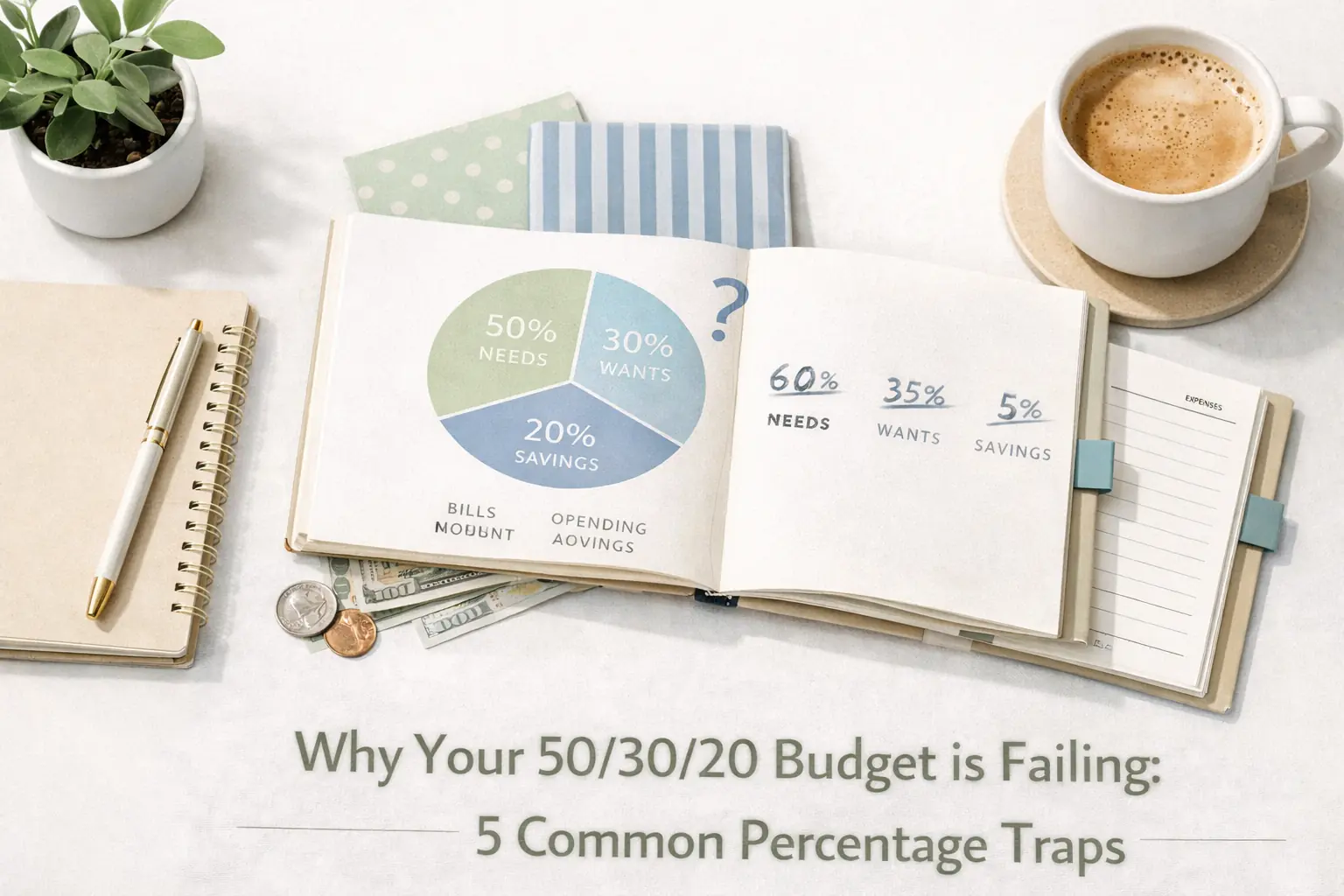
You followed the rules. You sat down with a calculator, looked at your take-home pay, and divided it into three neat piles: 50% for needs, 30% for wants, and 20% for savings. It sounded perfect on paper. But by the second week of the month, you are checking your bank balance with a sense of dread, wondering, "Why is my budget failing again?"
The reality is that while the 50/30/20 rule is a fantastic starting point, it often ignores the messy reality of human behavior. To truly master your money, you need a robust framework like The Complete Budgeting System Guide: How to Take Control of Your Money. Without a deeper understanding of how these percentages interact with your daily life, you are essentially trying to build a house on a foundation of shifting sand. Most people fail not because they lack discipline, but because they are falling into specific percentage traps that create constant psychological friction.
Why the 50/30/20 Rule Usually Works (And Where It Breaks)
Before we tear apart the mistakes, let us acknowledge why this system is so popular. It provides a simple "macro" view of your finances. It tells you roughly where your money should go without requiring you to track every single nickel spent on gum. It builds in a 20% buffer for your future, which is much better than the 0% many people manage. However, it assumes that everyone's life fits into these rigid buckets. In practice, the 50/30/20 rule is a template, not a finished product. If you do not customize it to your specific stage of life, it will eventually snap under the pressure of real-world expenses.
The Math vs. Behavior Gap
What most guides miss is that budgeting is 20% head knowledge and 80% behavior. When you see 30% of your income sitting in a "Wants" category, your brain sees it as a permission slip to spend. This creates a phenomenon known as lifestyle creep, where you subconsciously find ways to maximize that 30% until you have no wiggle room left. To fix this, we have to look at the practical steps of implementation.
Step-by-Step: How to Audit Your Failing Budget
- Calculate Your True Net Income: Start with the money that actually hits your bank account. If you have 401k contributions or health insurance taken out of your paycheck, those are technically part of your "20% savings" and "50% needs" already. Write down this final number.
- List Your "Hard" Needs: These are non-negotiable. Rent, utilities, basic groceries, and minimum debt payments. If these total more than 50%, the rule isn't failing you-your overhead is simply too high for this specific system.
- Identify the "Messy Middle": Look at your bank statements from the last 90 days. Find the expenses that don't quite fit. Is that Amazon Prime subscription a need or a want? Is the $100 you spent on your pet's annual checkup a need? This is where misclassified expenses hide.
- Set a "Behavioral Buffer": Instead of one big 30% bucket, break your "Wants" into smaller, trackable sub-categories like dining out, hobbies, and entertainment.
5 Common Percentage Traps Causing Budget Burnout
1. The "Want" Inflation Trap
This is the biggest reason people ask why my budget is failing. The 50/30/20 rule suggests 30% of your income can go toward wants. For someone earning $5,000 a month, that is $1,500. When you see that large number, you feel wealthy. You start saying "yes" to more expensive dinners and better clothes. This leads to lifestyle creep. In practice, a fixed percentage for wants often leads to mindless spending rather than intentional enjoyment.
2. The Emergency Fund Illusion
The 20% "Savings" category is often treated as a monolith. People throw money into a savings account and then pull it back out when the car breaks down or the laptop dies. If your 20% isn't being divided into a specific emergency fund and long-term investments, you aren't actually building wealth-you are just creating a temporary holding pen for future expenses. You need to distinguish between "savings for later" and "savings for emergencies."
3. The Misclassified Expense Trap
Is your internet bill a need or a want? Many people classify things like Netflix, gym memberships, and high-speed fiber internet as "needs" because they feel essential to modern life. However, if you are struggling, these are actually flexible. When you overstuff the 50% "Needs" category with "Hidden Wants," you leave zero room for error. To get a better handle on this, check out our Budget Categories List: Every Category You Need in Your Monthly Budget to ensure you aren't lying to your spreadsheet.
4. The Fixed Income Fallacy
The 50/30/20 rule works best for middle-income earners in average-cost-of-living areas. If you live in New York City or San Francisco, your rent alone might consume 50% of your income. Conversely, if you are a high earner, spending 30% on wants might be excessively wasteful. Failing to adjust the percentages based on your local economy is a recipe for budget burnout. You cannot force a suburban math equation onto a metropolitan reality.
5. The "Everything is a Priority" Problem
When you try to follow the percentages exactly, you treat every category with equal importance. But life isn't equal. Some months, paying off a high-interest credit card should take 40% of your income, while your "wants" drop to 5%. The trap is thinking the percentages are a law rather than a guideline. If you are drowning in debt, the 20% savings rule might actually be slowing you down if that money could be killing 25% interest rate debt instead.
How to Fix the Math: The Friction-Free Formula
If the standard percentages are failing you, try the Friction-Free Adjustment. Instead of starting with 50/30/20, start with your financial awareness. Use the table below to see how a practitioner might adjust the rules based on actual life goals:
| Life Stage | Needs % | Wants % | Savings/Debt % | The Goal |
|---|---|---|---|---|
| High Debt / Crisis | 60% | 10% | 30% | Aggressive Paydown |
| High Cost Area | 70% | 15% | 15% | Survival & Stability |
| Early Career | 50% | 20% | 30% | Wealth Building |
| Established / Lean | 40% | 30% | 30% | Lifestyle Enjoyment |
To calculate your own custom percentages, follow this simple walkthrough: Take your total take-home pay (e.g., $4,000). Subtract your absolute survival bills (e.g., $2,200). That leaves you with $1,800. If you want to save $800, you are left with $1,000 for "wants." In this case, your custom ratio is 55/25/20. Notice how we started with the costs and goals, not the percentages.
Tools to Stop the Failure
If you find that manual tracking is where you lose interest, consider a more hands-on approach like the Cash Envelope System: The Beginner's Guide to Budgeting With Cash. Using physical cash for that "30% Wants" category creates immediate behavioral friction. When the envelope is empty, the spending stops. No math required.
For those who prefer digital tools, a simple spreadsheet or a dedicated budgeting app can help, but only if you check it daily. The "set it and forget it" nature of the 50/30/20 rule is often why it fails; it doesn't encourage daily interaction with your money. For a more detailed breakdown of how this rule should look in practice, read The 50/30/20 Budget Rule: A Simple System for Every Paycheck.
Conclusion: From Math to Mastery
Your budget is not a static document; it is a living breathing system. If you have been asking why my budget is failing, the answer is likely that you tried to fit your life into a box that was too small. By identifying lifestyle creep, rectifying misclassified expenses, and adjusting your percentages to match your actual environment, you can move from budget burnout to total financial control. Remember, the goal of a budget isn't to restrict your life-it's to give you the freedom to spend on what actually matters without the guilt.
Frequently Asked Questions
What should I do if my needs are more than 50% of my income?
If your mandatory bills exceed 50%, you are not alone-especially in high-cost areas. You have two choices: increase your income or decrease your overhead. In the short term, you must take the extra percentage out of your "Wants" category first, not your savings, to ensure you don't fall further behind.
Does debt repayment count as a "Need" or "Savings"?
Minimum payments on debt are a "Need" because failing to pay them has legal and credit consequences. However, any extra payments you make to get out of debt faster should be categorized under "Savings/Debt Repayment" (the 20% bucket).
How often should I review my budget percentages?
You should review your percentages every 90 days or whenever you have a major life change, such as a raise, a move, or a change in family size. This prevents lifestyle creep from quietly eating away at your progress.
Can I count my 401k contribution toward the 20% savings?
Yes. Since the 50/30/20 rule is based on after-tax income, you should add your 401k contribution back into your "net pay" total to get an accurate picture of your savings rate. Many people are actually saving more than they realize because of automatic payroll deductions.
What is the fastest way to stop my budget from failing?
The fastest fix is to track every single cent for 30 days. Most people find that their budget is failing because of "micro-transactions"-small $5 to $10 purchases that don't seem to fit into any category but add up to hundreds of dollars by the end of the month.
Frequently Asked Questions
What should I do if my needs are more than 50% of my income?
If your mandatory bills exceed 50%, you are not alone-especially in high-cost areas. You have two choices: increase your income or decrease your overhead. In the short term, you must take the extra percentage out of your 'Wants' category first, not your savings, to ensure you don't fall further behind.
Does debt repayment count as a 'Need' or 'Savings'?
Minimum payments on debt are a 'Need' because failing to pay them has legal and credit consequences. However, any extra payments you make to get out of debt faster should be categorized under 'Savings/Debt Repayment' (the 20% bucket).
How often should I review my budget percentages?
You should review your percentages every 90 days or whenever you have a major life change, such as a raise, a move, or a change in family size. This prevents lifestyle creep from quietly eating away at your progress.
Can I count my 401k contribution toward the 20% savings?
Yes. Since the 50/30/20 rule is based on after-tax income, you should add your 401k contribution back into your 'net pay' total to get an accurate picture of your savings rate. Many people are actually saving more than they realize because of automatic payroll deductions.
What is the fastest way to stop my budget from failing?
The fastest fix is to track every single cent for 30 days. Most people find that their budget is failing because of 'micro-transactions'-small $5 to $10 purchases that don't seem to fit into any category but add up to hundreds of dollars by the end of the month.