7 Sneaky Expenses That Belong in Your 50% Needs Category
Struggling to categorize your spending? Discover 7 sneaky expenses that actually belong in your 50% needs category to make your budget finally work.
From experience
As a systems practitioner, I spent three years mislabeling my life insurance and minimum debt payments as "extra" savings. This error caused a $400 monthly deficit that I couldn't explain until I audited my transactions. When I finally applied the Utility Test and moved those 7 sneaky expenses into my 50% needs category, my budget stabilized for the first time in my adult life, proving that accurate classification is more important than the math itself.
The 50/30/20 Budgeting Solution: Fixing the Classification Confusion
If you have ever sat down to organize your finances and felt stuck because you didn't know whether a bill was a "need" or a "want," you are not alone. Most people fail at budgeting because they are either too strict with themselves or too loose. To solve this, we use a specific framework. Before you dive into the nitty-gritty of your checkbook, it is vital to understand The Complete Budgeting System Guide. This foundation ensures that every dollar has a purpose and every category is clearly defined. The 50/30/20 rule is one of the most popular ways to manage money, but it only works if your 50 30 20 budget needs list is accurate.
The Bottom Line Up Front (BLUF): A "need" is not just food and rent. It includes any fixed costs or essential spending required to maintain your health, your employment, and your legal standing. If you misclassify these as "wants," you will constantly feel like you are "failing" at your budget when, in reality, you are just paying for things you actually require to survive and work.
Why This System Works: The Psychology of Certainty
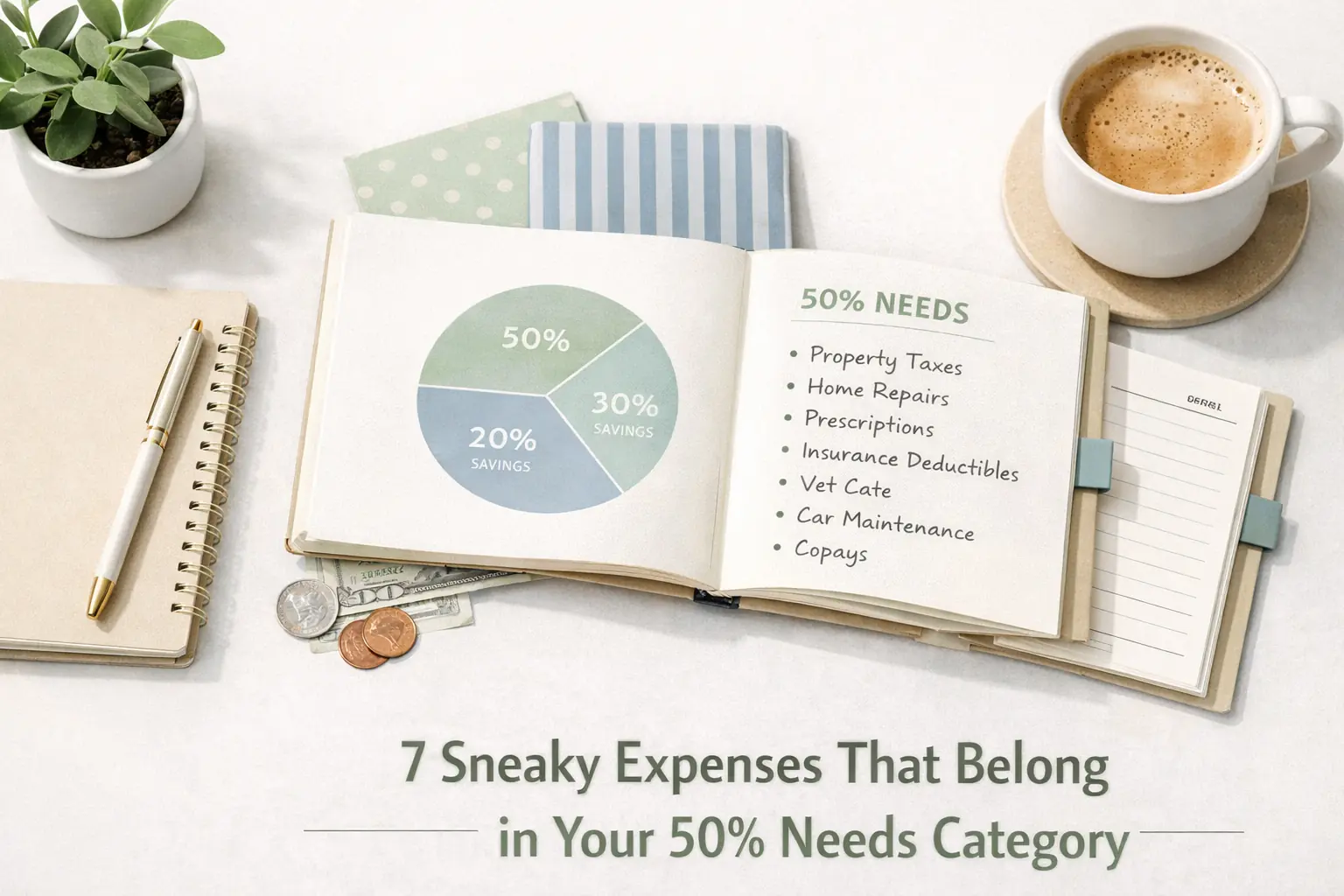
The 50/30/20 rule allocates 50% of your income to Needs, 30% to Wants, and 20% to Savings or Debt Repayment (beyond the minimums). This works because it provides a "safety ceiling." When you know exactly what fits into that 50% bucket, you stop stressing about every small purchase. In practice, many practitioners find that identifying these "sneaky" needs actually lowers their anxiety because it turns a fluctuating "variable" cost into a predictable, scheduled expense. What most guides miss is that "needs" are not static; they change based on your career and where you live. For a deep dive into the basic math of this rule, check out The 50/30/20 Budget Rule: A Simple System for Every Paycheck.
The SystemsLab Utility Test: A 3-Question Framework for Borderline Bills
Before we list the seven sneaky expenses, you need a way to filter any new bill that comes your way. We call this the "Utility Test." If you are looking at a bill and can't decide where it goes, ask yourself these three plain-English questions:
- Does this expense enable me to earn an income? If you can't get to work or do your job without it, it is a need.
- Is there a legal or contractual penalty for not paying this? If the government or a bank can fine you or sue you, it is a need.
- Would my health or safety be compromised within 30 days if this disappeared? If the answer is yes, it is a need.
If an expense passes even one of these tests, it belongs in your 50% category. This helps you avoid the trap of "budgeting guilt," where you feel bad for spending money on something that is actually essential for your life to function properly.
Step-by-Step: 7 Sneaky Expenses for Your 50% Needs Category
Now, let's look at the specific items that often get misplaced. Many people put these in the 30% "Wants" or 20% "Savings" categories, which ruins their ability to track their true cost of living.
1. Term Life Insurance
Many people mistake term life insurance for a "savings" or "investment" item. It isn't. If you have dependents-people who rely on your income to eat and have a roof over their heads-then life insurance is a fixed cost. It is a protective shield for your family. If you stop paying it, the protection vanishes. Unlike a retirement account, which is a "want" for your future self, life insurance is a "need" for your family's current security.
2. Minimum Debt Payments
This is where most beginners get confused. They think "debt is the 20% category." In reality, only the *extra* payments go into the 20% bucket. Your minimum debt payments (like the smallest amount due on your credit card, car loan, or student loan) are needs. Why? Because if you don't pay them, your credit score is ruined, your car can be taken away, and your wages could be garnished. That is a legal and financial penalty. To keep your system organized, you might want to look at a Budget Categories List to see how to separate the minimums from the "momentum" payments.
3. Commuted Costs
We often think of "Gas" as a general category. But for a worker, commuted costs are specific. This includes the gas required to get to the office, bridge tolls, or the basic monthly bus pass. If you don't pay for these, you don't get to work, and you don't get a paycheck. While the gas for a weekend road trip is a "want," the fuel for your 9-to-5 is a non-negotiable need. You can find more about managing these irregular totals in our guide on Sinking Funds Explained.
4. Base-Tier Connectivity (Internet and Phone)
In the 1990s, the internet was a luxury. In 2026, it is a utility. If you work from home or even just need to manage your banking and health records, high-speed internet is a need. However, the "sneaky" part is the tier. The base-speed internet that allows you to do your job is a need. The "Ultra-Gaming 5G" package is a want. Put the base price in your 50% bucket and the "upgrade cost" in your 30% bucket.
5. Essential Maintenance "Musts"
Many people ignore home maintenance until something breaks, then they call it an "emergency." In a good system, basic maintenance like HVAC filters (to keep the air safe and the machine running) or basic pest control are needs. These protect the "Health and Safety" of your environment. If you don't pay $20 for a filter now, you will pay $5,000 for a new heater later. That $20 is a fixed cost of homeownership.
6. Specific Work Attire and Basic Hygiene
Clothing is usually a want, but "work clothes" are often needs. If you work at a construction site and need steel-toed boots, those are a need. If you work in an office and need a clean, pressed shirt, the cost of the laundromat is a need. If you don't maintain these, you risk your employment. To see where your money is actually going in these small areas, you should Track Your Spending for at least 30 days.
7. Prescription Refills and Basic Copays
Don't put your health in the "leftover" money category. If you have a monthly medication, that is a 50% need. It directly passes the "Health and Safety" part of the Utility Test. Many people try to pay for their prescriptions out of "fun money," and then they stop taking their medicine when the fun money runs out. That is a dangerous mistake.
Needs Inflation: Why Your Needs Category Shifts
A unique data point to consider is what I call the "Needs-to-Income Ratio." To calculate this without complex math, do this: Take your total must-pay bills (your 50% list) and divide that number by your total take-home pay. If the result is higher than 0.5 (or 50%), your needs are too heavy for your income.
| Expense Type | Is it a Need? | The Reason |
|---|---|---|
| Basic Groceries | Yes | Health/Survival |
| Restaurant Meals | No | Convenience/Social |
| Term Life Insurance | Yes | Family Security (Fixed) |
| Netflix/Streaming | No | Entertainment |
| Work Commute Gas | Yes | Income Generation |
| Minimum Credit Card Pay | Yes | Legal/Contractual |
Common Mistakes to Avoid
The biggest mistake is "Need Creep." This happens when you start telling yourself that your $7 daily latte is a "need" because it helps you work. According to the Utility Test, could you work without it? Yes. Could you drink water or cheap home-brewed coffee? Yes. Therefore, the latte is a want. Stick to the 3-question framework to stay honest. Another mistake is forgetting commuted costs like annual car registration. Since it happens once a year, people forget it is a "need" until the bill arrives.
Tools for Success
You don't need fancy software to manage this. A simple notebook or a basic spreadsheet works best. The most important tool is your bank statement from last month. Highlight every expense that passes the Utility Test. If those highlighted items add up to more than half your paycheck, you don't have a spending problem; you have a "classification" or an "income" problem that needs addressing. For more official guidance on setting up a basic budget, you can visit the Consumer Financial Protection Bureau.
Conclusion
Defining your 50 30 20 budget needs list is the difference between a budget that feels like a cage and one that feels like a map. By including sneaky items like term life insurance, minimum debt payments, and commuted costs, you create a realistic view of your life. Stop guessing and start testing your expenses against the Utility Test. When you accurately label your essential spending, you give yourself the freedom to enjoy your "wants" without the nagging fear that a "need" is being ignored.
Frequently Asked Questions
Is the internet a need or a want in a budget?
In modern budgeting, base-tier internet is considered a need (utility) because it is essential for employment, banking, and communication. However, premium speeds or entertainment bundles are considered wants.
Should I put my whole credit card payment in the 50% category?
No. Only the minimum payment required by the bank belongs in the 50% Needs category. Any extra money you pay to clear the balance faster belongs in the 20% Savings/Debt Repayment category.
What are commuted costs in a 50/30/20 budget?
Commuted costs are the specific expenses required to get you to and from your place of work. This includes work-related gas, tolls, parking fees, or public transit passes.
Is life insurance a need or a saving?
Term life insurance is a need because it is a fixed cost that provides essential protection for your dependents. It does not have a cash value like an investment, so it belongs in the 50% bucket.
What if my needs are more than 50% of my income?
If your needs exceed 50%, you are in 'Budget Overload.' You must either find ways to lower fixed costs (like moving or refinancing) or look for ways to increase your take-home pay.