How to Budget a Bi-Weekly Paycheck: The 2-Paycheck Calendar Method
Stop the paycheck-to-paycheck cycle. Learn the 2-Paycheck Calendar method to split big bills like rent and master your bi-weekly cash flow once and for all.
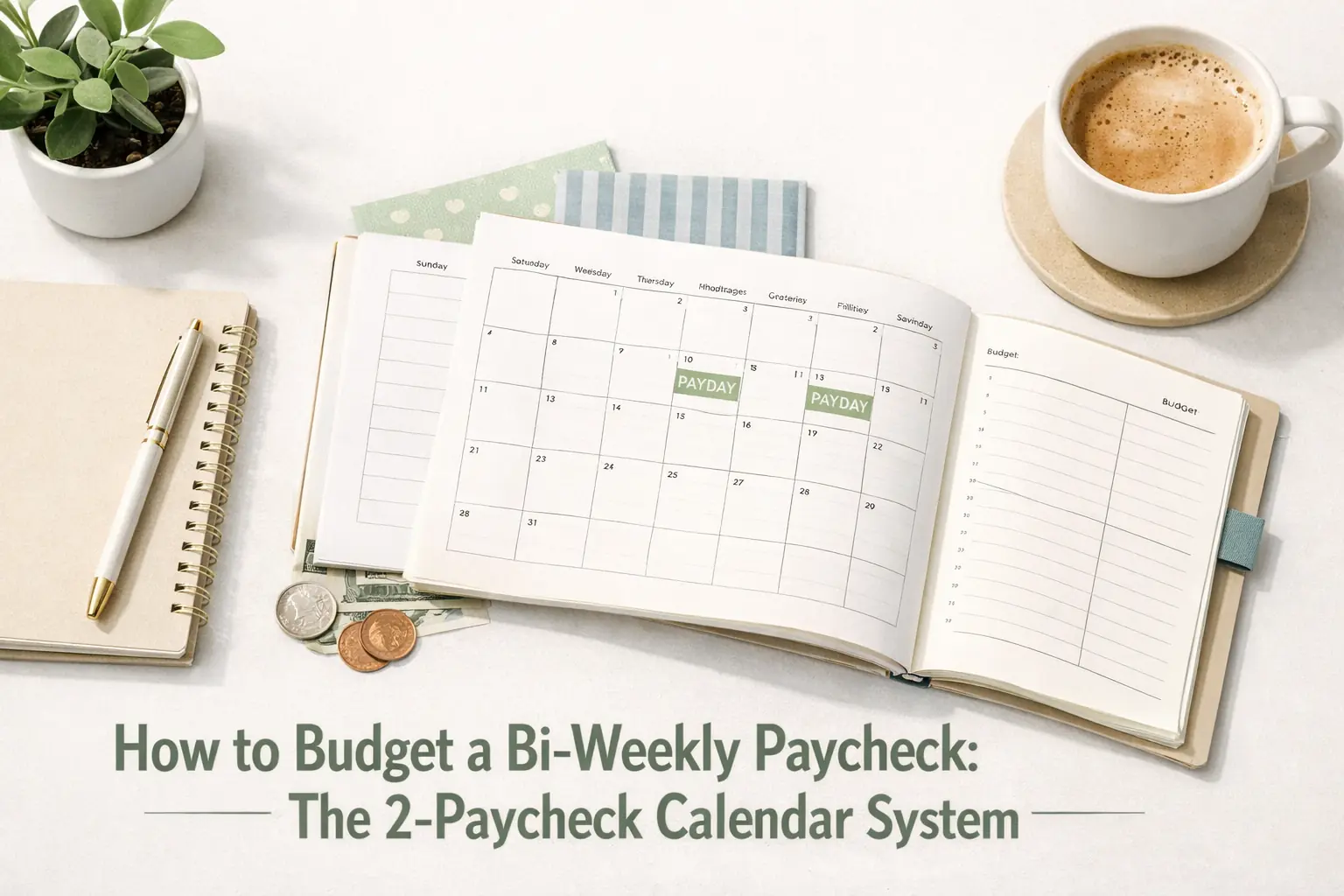
From experience
For years, my first paycheck of the month was entirely eaten by my $1,200 mortgage, leaving me effectively broke until the 15th. Once I implemented the 2-Paycheck Calendar and started "parking" exactly $600 from every single check into a dedicated bills account, the mid-month panic completely vanished. Now, I consistently have the full payment ready three days before the 1st without ever feeling "short" on my second pay period.
The Bi-Weekly Paycheck Struggle: Why the Timing Never Seems Right
Getting paid every two weeks is the most common pay cycle in the world, yet it is often the hardest one to manage. If you have ever felt flush with cash on the first Friday of the month only to be broke by the third because the rent check cleared, you are not alone. This "timing gap" is the number one reason budgets fail. To truly win with your money, you need more than just a list of expenses; you need a strategy that aligns with your specific pay dates. This is where The Complete Budgeting System Guide: How to Take Control of Your Money serves as your foundation, but today we are zooming in on the mechanics of the bi-weekly cycle.
Most people try to create a monthly budget, but monthly budgets assume you get all your money on the 1st. In reality, your bills are scattered throughout thirty days, while your income arrives in two (and occasionally three) distinct chunks. To fix this, we have to move away from "monthly thinking" and toward "paycheck thinking." This article will walk you through the 2-Paycheck Calendar method-a practical way to ensure your bills are covered without the mid-month panic.
Why the 2-Paycheck Calendar Method Works for Bi-Weekly Pay
The 2-Paycheck Calendar method works because it treats your finances like a logistics problem rather than a math problem. When you use a Paycheck Budget System, you aren't just looking at how much you spend; you are looking at when you spend it. By mapping out your bills on a physical or digital calendar, you can visualize the distance between your payday and your due dates. This prevents the "big bill" syndrome, where one paycheck is completely swallowed by rent or a mortgage, leaving you with nothing for groceries or gas for the next fourteen days.
In practice, I have found that most people fail because they treat their bank balance as "available spending money" right after they get paid. They see $2,000 in the account and think they are doing great, forgetting that $1,200 of that is spoken for by a bill due ten days later. The 2-Paycheck method creates a mental (and physical) barrier that protects that money before you have a chance to spend it on something else.
The Bill-Splitter Formula: Handling Large Payments Without Stress
This is the secret sauce that most budgeting guides miss. If your rent is $1,400 and your bi-weekly paycheck is $2,200, taking that entire $1,400 out of one check is a recipe for disaster. It leaves you with only $800 to cover everything else for two weeks. Instead, we use the Bill-Splitter Formula.
How the Bill-Splitter Formula Works
Take your largest monthly bills (usually housing and car payments) and divide them by two. You will set aside this "half-payment" from every single paycheck, regardless of when the bill is actually due. Let's look at a real-world example:
- Total Rent: $1,200
- Check A: Set aside $600 into a separate "Bills" account or a digital folder.
- Check B: Set aside $600.
- Result: When the 1st of the month rolls around, the full $1,200 is ready and waiting, and neither paycheck felt the full weight of the expense.
This simple division ensures a smooth cash flow management experience. You aren't "rich" one week and "poor" the next. You are consistently prepared. If you find your spending categories are still a bit messy, checking out a comprehensive Budget Categories List can help you identify other bills that might benefit from being split this way.
The Step-by-Step Bi-Weekly Payday Routine
To make this work, you need a payday routine. This shouldn't take more than fifteen minutes every two weeks. If it takes longer, you are overcomplicating it. Here is the exact workflow to follow:
Step 1: The Calendar Audit
Look at the next 14 days on your bill calendar. Identify every bill that will come out before your next payday. Don't just look at the due dates; look at the "withdraw dates." If a bill is due on the 15th but your next payday is the 16th, that bill must be paid with your current check.
Step 2: Apply the Bill-Splitter
Calculate your half-payments for the large expenses that aren't due in this current window. Move that money immediately. If you use a bank that allows for "buckets" or "vaults," this is the perfect place to store those funds so they don't show up in your "available" balance.
Step 3: Fund Your Variable Envelopes
Now that the fixed bills and split payments are covered, you can look at what is left for your daily life. This is where you fund your groceries, gas, and entertainment. Many people find success using a Simple Spending Tracking System to make sure these variable costs don't creep up and eat into next week's bill money.
Step 4: The Buffer Check
Always leave a small "buffer" in your checking account-roughly $50 to $100. This is for those tiny transactions you forgot about, like a monthly app subscription or a price hike in your utility bill. It prevents overdraft fees, which are the enemy of any good budget.
Unique Angle: Managing the "Invisible Transitions"
What most guides miss is the "Invisible Transition." This is the 2-3 day period between when you get paid and when your auto-pays actually clear the bank. On Friday morning, your bank app says you have $2,500. You feel great! You go out to dinner. But in reality, three auto-pays are "pending" and won't actually deduct from that total until Monday. This creates a false sense of security.
To manage this, you must base your budget on your **ledger balance**, not your **available balance**. Your ledger is what you *actually* have after you subtract every bill you know is coming. This is the practitioner's secret: never trust the number on the ATM screen. Trust your calendar.
Unique Angle: The Psychology of the "Third Paycheck" Month
Two times a year, because there are 52 weeks in a year, those of us on a bi-weekly pay cycle get three paychecks in a single month. Most people treat this as "free money" and blow it on a vacation or electronics. While that is tempting, there is a better way to use it within the 2-paycheck calendar method.
Think of the third paycheck as a "Systems Reset." Use this extra money to:
- Get one full month ahead on your bills.
- Fully fund your Sinking Funds for things like car tires or holiday gifts.
- Pay off a small credit card balance.
Unique Angle: The Paycheck A vs. Paycheck B Split-Screen
To visualize this, imagine your month as two distinct zones. Paycheck A (the first check of the month) typically covers the "Front-Loaded Bills" like rent, electricity, and the first half of your car payment. Paycheck B (the second check) covers "Back-Loaded Bills" like your cell phone, internet, the second half of the car payment, and savings goals.
In practice, people often find that one paycheck is "heavier" than the other. This is why the Bill-Splitter formula is non-negotiable. If you don't split those big costs, Paycheck A might have $1,800 in bills while Paycheck B only has $400. That imbalance leads to stress and overspending during the "light" weeks. Equalizing the load between the two checks is what creates the "stress-free" feeling of this method.
Common Mistakes with Bi-Weekly Budgeting
- The Friday Splurge: Spending too much on "Payday Friday" before the bills clear on Monday.
- Ignoring the Calendar: Assuming that because you have money today, you have money for a bill due in 10 days.
- Forgetting Irregular Bills: Things like quarterly car insurance or annual subscriptions. Always use the Splitter formula for these-divide the annual cost by 26 pay periods and save that tiny amount every time.
- Not Adjusting for 31-Day Months: Some months are longer than others, meaning you might need an extra week of grocery money. Always check the calendar for those 5-week stretches between paychecks.
Conclusion: Consistency Over Complexity
Budgeting a bi-weekly paycheck doesn't require a degree in finance or a complex spreadsheet. It requires a calendar, a pen, and the discipline to split your largest bills in half. By following the 2-Paycheck Calendar method, you turn your income into a steady, predictable stream rather than a series of highs and lows. Start today by identifying your "Big Bill" and committing to saving half of it from your very next paycheck. Once you master the timing, the math takes care of itself.
Frequently Asked Questions
What is the best way to handle rent if it's more than half my paycheck?
If your rent is extremely high relative to your income, the Bill-Splitter formula is even more critical. You may need to start by setting aside a smaller amount from three paychecks in a row to 'buffer' the account so that eventually, you are only taking half from each current check.
How do I handle months with three paychecks?
Treat the third paycheck as a 'bonus' for your goals. Since your monthly bills are already covered by the first two checks (using the 2-paycheck method), this extra money can go directly to debt, savings, or a special purchase without affecting your standard budget.
Should I have a separate bank account for my bill money?
Yes, many people find it helpful to have a separate 'Bills' checking account. You deposit your bill money there and never touch the debit card for that account, while your variable spending stays in a different account.
What if my bills are all due at the beginning of the month?
This is a common issue. To fix it, you use the Bill-Splitter formula. By saving half of those early-month bills from your last paycheck of the *previous* month, you ensure the money is ready when the 1st arrives.
How do I account for groceries in a bi-weekly budget?
Budget for groceries in 14-day chunks. If you usually spend $200 a week, you must set aside $400 every payday. Be careful during 5-week months where you might need an extra 'grocery week' of cash.